The worklist
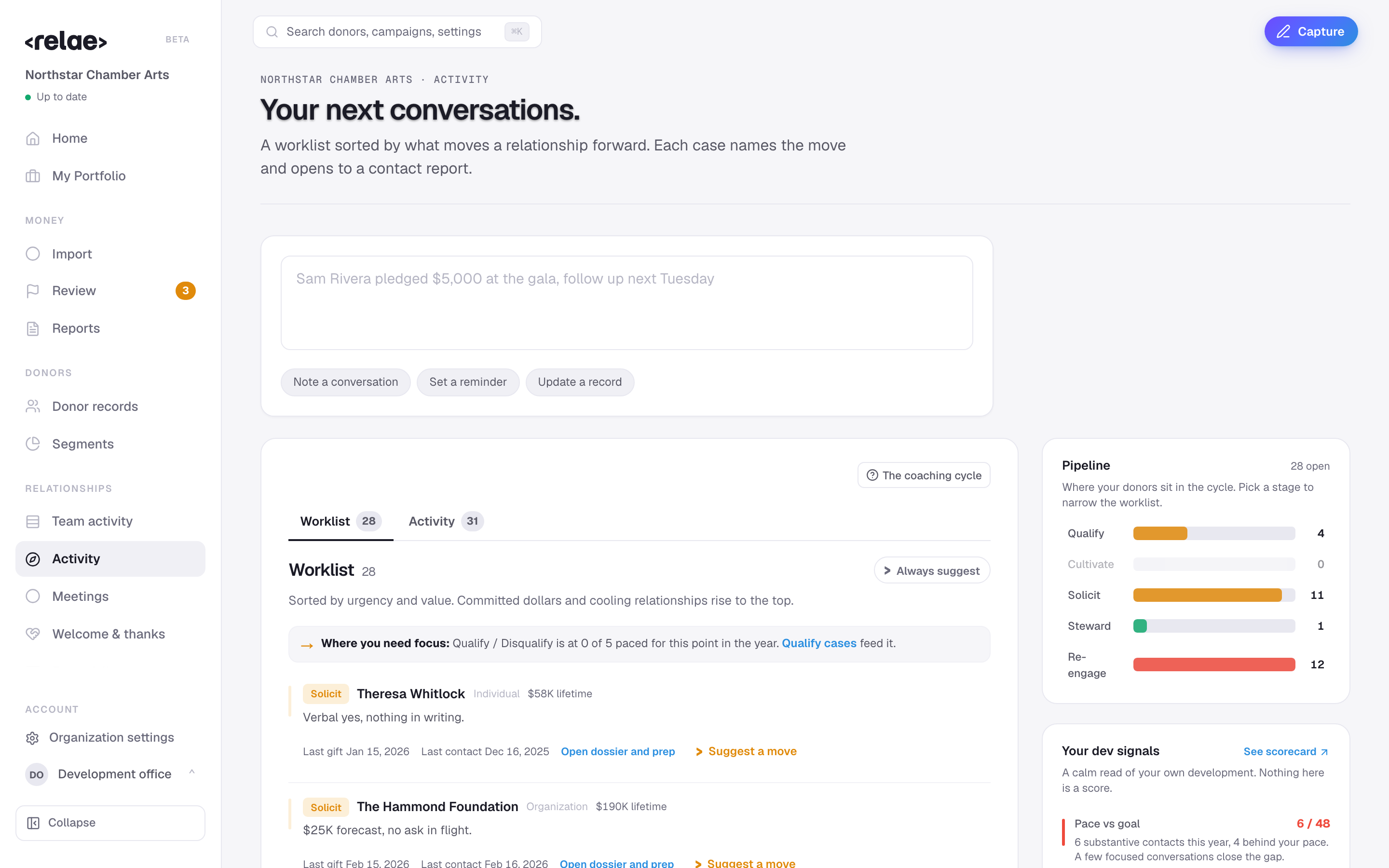
The worklist answers the question a one-person shop asks every Monday: out of several hundred donors, who should I talk to this week?
What it is
Section titled “What it is”A short, ordered list. Each row names one person, the stage they are at, their lifetime giving, and a sentence saying why they surfaced now. It is sorted by what moves a relationship forward, not by gift size.
The suggested move is not on the row. You ask for it, and it appears beside the reason. That order is deliberate: the observation reaches you before the recommendation, so you judge the situation rather than the suggestion.
Opening an item takes you to the person and, when the conversation happens, to a contact report where you record what was said.
Why things surface
Section titled “Why things surface”The reasons are the ordinary rhythms of fundraising:
- A first gift arrived. New donors are most receptive immediately after giving, and the window is days rather than weeks.
- A major gift arrived. Large gifts deserve a personal response quickly.
- Somebody lapsed. A reliable donor who has not given this year. Cheaper to recover than to replace.
- A first-time donor has gone quiet. They gave once, months ago, and nothing since. The second gift is the one that makes a donor.
- A prospect is ready. Ratings and history suggest a conversation is due.
- A commitment is overdue. You said you would follow up and the date has passed.
Why it is short
Section titled “Why it is short”A list of two hundred names is a list nobody works. The worklist gives you the few things worth attention now, with the rest available on demand.
If the top items do not suit your week, skip them. Skipping is information, and the list learns from it.
Moves management
Section titled “Moves management”The sector term for planned relationship work is moves management. A move is any deliberate action that advances a relationship: a coffee, a tour, a programme update, an ask. The idea is that major gifts follow from a planned sequence of moves rather than a well-timed letter.
The worklist is that discipline running for you, without you keeping the plan in your head or a spreadsheet.
The usual stages are qualification (is this a real prospect), cultivation (building the relationship), solicitation (the ask), and stewardship (what happens after). Relae tracks which stage each prospect is at and what the last and next moves were.
Portfolios
Section titled “Portfolios”A portfolio is the set of prospects one person is responsible for. In a one-person shop that is everything, and the useful question is which subset you are actively working.
You set a cap on how many relationships one person is expected to hold, and Relae flags a list that passes it. It is called the caseload soft cap, and it lives in workspace settings. Soft, because nothing is blocked: you are told, and you decide.
The number is yours. Large development shops, where carrying a book is somebody’s whole job, work to somewhere between 75 and 150 people. That figure is context for choosing, not a standard to reach. If fundraising is one of four jobs you hold, a list of twenty people you speak to is worth more than a hundred you do not, and setting the cap there is the system working as intended rather than a smaller version of someone else’s.
Pick a number you can keep up with, and move it when you learn you were wrong.
- Working the worklist, for the routine.
- Affinity, access and capacity, for what feeds the order.