Your first week
This is the order that works. Each day depends on the one before it, and none of them takes a full day. Total time is around four hours across the week.
Day one: get your history in
Section titled “Day one: get your history in”-
Create the workspace. Name it as your organization is known publicly, since it appears on receipts and reports.
-
Set your fiscal year. This decides which year every gift counts in, so it is worth getting right before the data lands.
-
Import your giving history. Whatever you have. A spreadsheet, a CRM export, several platform exports. Relae reads the columns and asks you about anything it cannot place.
Import the oldest data you have, not the last twelve months. Lifetime giving is what makes a donor’s pattern legible, and a two-year window hides most of it.
See import your giving history for the detail.
Day two: work the review queue once
Section titled “Day two: work the review queue once”The import will leave some gifts the engine could not confidently attach to a person. Clear them once, now, while the data is fresh in your mind.
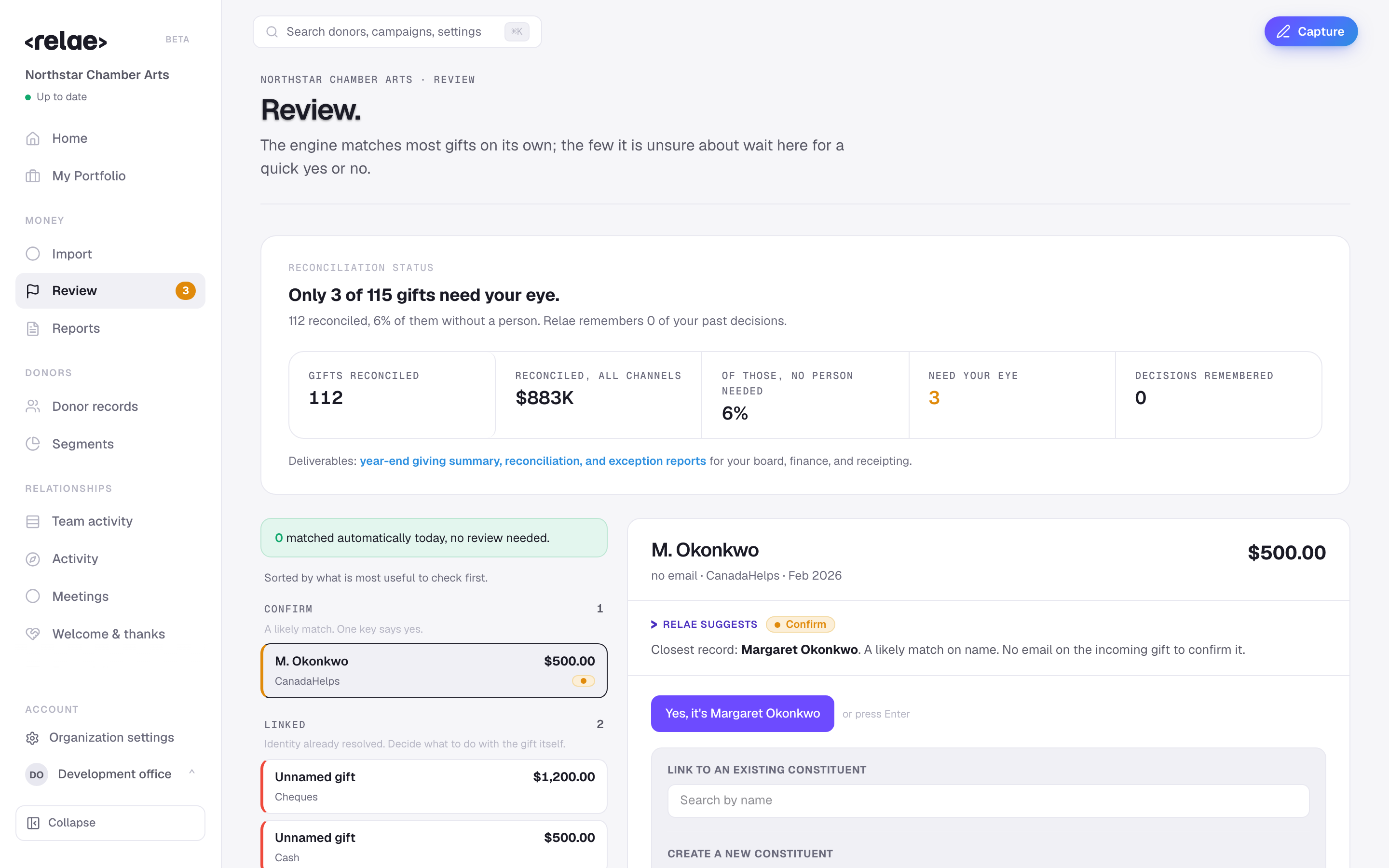
Decisions you make here are remembered. A name spelled one way at the box office and another way on a cheque is a question you answer once, ever.
See reconciling gifts.
Day three: check your top thirty
Section titled “Day three: check your top thirty”Sort your donor records by lifetime giving and read the top thirty. You are looking for two things:
- Records that are wrong. Two entries that are one person, or a household counted as an individual. Fix them now, before anything downstream reads them.
- Names you did not expect. There is almost always someone in the top thirty you had not been thinking about. That is the first thing a clean record gives you.
Day four: rate the people you know
Section titled “Day four: rate the people you know”Open the top twenty or thirty records and set their ratings. Relae reads affinity from their giving on its own. You supply the two things only a person knows: whether anyone can open the door, and roughly what they could give.
If you do not know, leave it unset. An unset rating is honest. A guessed one misleads you for a year.
Read affinity, access and capacity first if the framework is new to you. It takes ten minutes and it is the single most useful thing in these docs.
Day five: look at your worklist and your forecast
Section titled “Day five: look at your worklist and your forecast”Two things to look at, in this order.
The worklist now has enough to work with. It gives you a short ordered list of conversations, each with the reason it surfaced. Pick two and do them.
The forecast shows the year against your goal in three bands: what you have raised, what you expect, and what you would have if every outstanding ask landed. That is the number your board wants, and it is now live rather than assembled by hand.
After the first week
Section titled “After the first week”Two habits keep it true:
- Ten minutes a week in Review. Whatever arrived, sorted.
- Record conversations when they happen. A note written the same day is worth five written from memory in November.